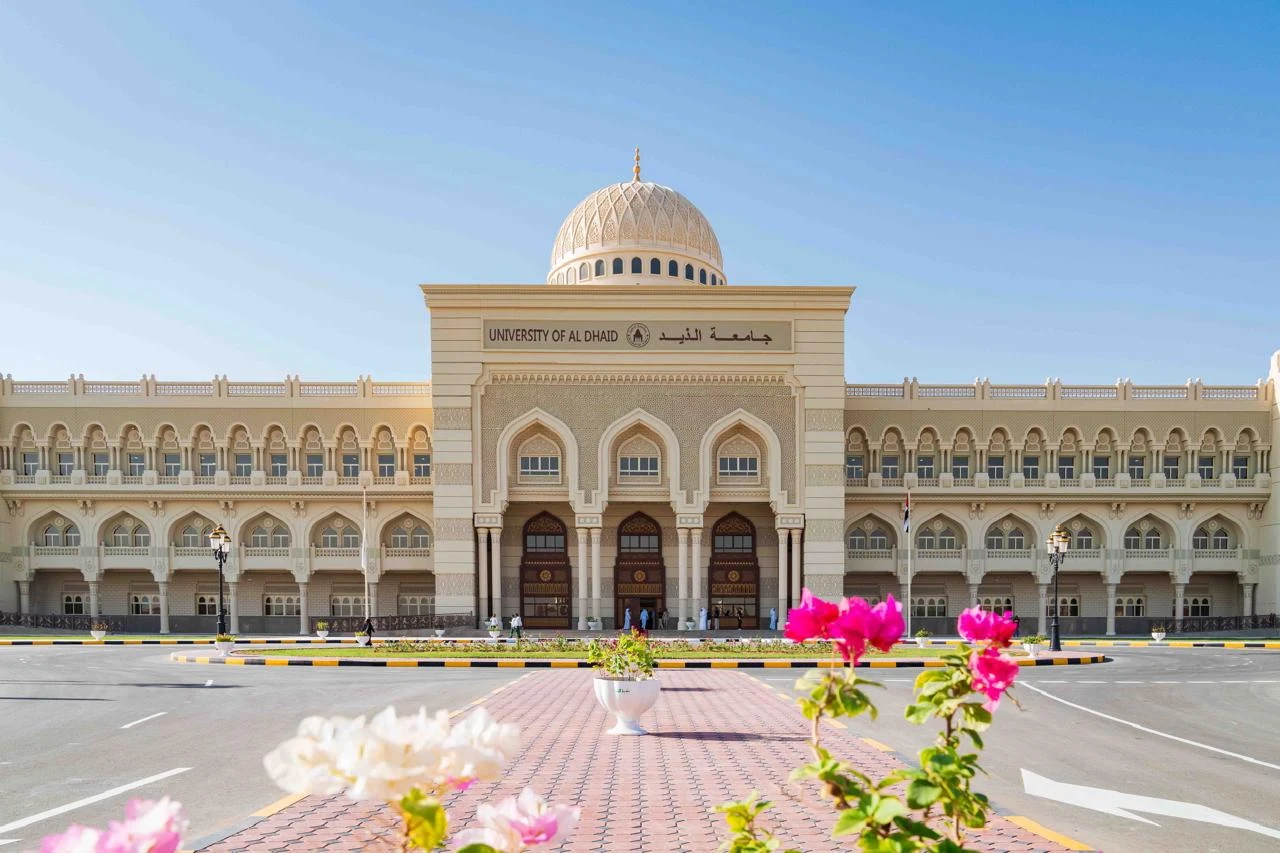
University of Al Dhaid gives central Sharjah a distinctive higher-education identity. Its emphasis on agriculture and veterinary medicine connects education with questions that are fundamental to a country’s resilience: food production, animal health, environmental resources and the responsible use of technology. Alongside these specialisms, its wider colleges create pathways in business, law, computing and the humanities. The institution is best understood through the relationship between specialist knowledge and the systems it can help improve.
A university established around strategic needs
The official institutional account dates the university’s establishment to 2024 by Emiri Decree issued by His Highness Sheikh Dr. Sultan bin Mohammed Al Qasimi. It describes a non-profit institution with an emphasis on education, research and community engagement. The founding purpose gives particular prominence to agriculture and veterinary medicine.
This specialisation invites a different way to view higher education. A university can contribute through the kinds of questions it makes possible to investigate: how production systems perform, how animals remain healthy, how natural resources are managed and how evidence informs decisions. Those questions connect local conditions with wider scientific and economic concerns without requiring the institution to imitate a general university model.
Agriculture and the study of sustainable production
The College of Agriculture presents practical, research-based study in sustainable agriculture. The admissions resource identifies a bachelor’s pathway in that field. Applicants should examine how the programme connects scientific foundations with applied learning and the environmental conditions relevant to production.
A serious interest in agriculture involves more than an enthusiasm for plants or farms. It includes the ability to interpret evidence, understand systems and evaluate trade-offs involving resources, productivity and ecological effects. Ask the college about the actual learning sequence, practical components and assessment. Where an external partnership is mentioned, clarify its educational role and avoid assuming that it changes the awarding institution or guarantees an overseas placement.
Veterinary medicine and the responsibilities of practice
The university describes a five-year Doctor of Veterinary Medicine programme developed in collaboration with the University of Liverpool. Applicants should verify the current study plan, admission criteria and the scope of the collaboration in the programme’s official documentation.
Veterinary education connects biological knowledge with observation, diagnosis, welfare and responsible decision-making. It also involves demanding practical and ethical obligations. A prospective student should ask how clinical skills are introduced, how supervised work is assessed and what requirements apply after graduation to professional practice. The degree title and duration do not by themselves resolve licensing or recognition in another jurisdiction.
Environment, technology and the wider academic structure
The current university site also identifies environmental sciences, computing and intelligent systems, law, business administration, and arts, humanities and social sciences. Its admissions information includes geology and computer science alongside other programmes. The computing leadership description explicitly relates digital fields to agriculture and veterinary contexts.
That creates an important area for enquiry: how can data, sensing or computational methods help understand living and environmental systems? Applicants should ask whether such intersections appear in their own degree plan, an elective, a supervised project or a research opportunity. A promising interdisciplinary connection should be verified at programme level rather than assumed from the coexistence of colleges.
Campus and the conditions for applied learning
The university describes a campus with a central library, classrooms, laboratories, research facilities and student-activity spaces. For applied subjects, the important question is how these resources are used in ordinary teaching. Access, supervision, safety and the progression from observation to independent competence all matter.
During a visit, ask to see the facilities relevant to the intended programme and discuss the typical weekly pattern. Find out which activities take place on campus and which may require travel. Students moving to the central region should examine transport and accommodation carefully. A well-informed decision links enthusiasm for the subject to a realistic understanding of the demands of daily study.
Entry requirements and choosing the right route
The admissions table distinguishes programmes and school qualification streams. Agriculture, veterinary medicine, computing and other routes do not share one universal threshold. Applicants should match their exact school background to the current requirements and ask about any additional language, subject or documentation conditions.
The financial decision should use the university’s written information for the intended academic year. Clarify tuition, practical or compulsory charges, deposits, refund rules and any confirmed sponsorship. Students considering a specialised professional degree should make recognition checks early. A route is strongest when academic readiness, practical expectations, professional progression and affordability have all been examined together.
Pathways worth exploring.
This is an orientation to the academic landscape, not an exhaustive catalogue or confirmation of open admissions. Use the official resources below to verify the exact award and current entry conditions.
| Field or pathway | What to investigate |
|---|---|
| Sustainable agriculture | The admissions resource identifies a bachelor’s route. Compare biological and production knowledge with practical methods, evidence interpretation and the constraints of responsible resource use. |
| Doctor of Veterinary Medicine | The university describes a five-year programme. Investigate the sequence of basic and clinical learning, supervised practice, welfare and safety requirements, and later professional recognition. |
| Environmental sciences and geology | The current institutional and admissions pages identify environmental study and a geology route. Confirm the exact degree and examine field, laboratory and analytical requirements. |
| Computer science | Review the mathematical and programming sequence, practical assignments and final project. Ask whether links to agriculture or veterinary applications are part of your actual study route. |
| Law and business administration | These routes provide distinct professional and analytical foundations. Compare the current study plan, teaching language and requirements for any later professional progression. |
| Humanities, communication and society | Admissions information identifies subjects including sociology, history-related tourism guidance and communication. Check the exact title and the relationship between academic study and practical assessment. |
Build your own decision record.
Programme and qualification
Record the exact award, level, teaching language, campus and intended intake. Keep a dated copy of the programme plan and entry conditions so that different institutions can be compared on the same basis. Ask about course sequencing, final assessment and practical or research requirements, including how additional preparation could affect the duration of study.
Cost and funding
Request current tuition and compulsory charges, then include accommodation, transport, materials and insurance where applicable. Separate confirmed figures from estimates and read deposit, instalment, refund and deferral terms. Do not deduct a potential scholarship from the budget until it is confirmed in writing, with coverage, continuation and exclusions understood.
Visit and unresolved questions
Prepare questions specific to the programme and record the answer, the responsible office and the date. Confirm practical arrangements, support, accessibility and supervision, together with later recognition where relevant. A useful visit goes beyond the appearance of the buildings: it helps explain how you will learn and manage an ordinary study week.
Questions that matter.
Are agriculture and veterinary entry requirements the same?+
No. The admissions table distinguishes programmes and school streams. Check your precise qualification against the intended degree and ask about subject and language conditions. Do not transfer a threshold from one programme to another.
Does the Liverpool collaboration create a UK degree?+
Do not infer that. The university describes collaboration in programme development. The awarding institution, study location and any mobility arrangements must be established from current official documentation for the exact degree.
What should a practical-campus visit cover?+
Focus on the facilities your programme actually uses, the timetable, supervision, safety and any off-campus requirements. Ask how practical competence is assessed and what costs or travel obligations accompany it.
Official resources for this portrait.
Institutional facts are grounded in the resources below. Interpretation and comparison guidance are independent editorial content. Programmes, fees and admission conditions may change after the review date.
- Establishment and university purpose ↗
- Colleges ↗
- Current academic fields ↗
- Admissions ↗
- President’s message ↗
- Computing and intelligent systems ↗
An independent editorial portrait. Inclusion does not imply endorsement, partnership or an admission offer from the institution.