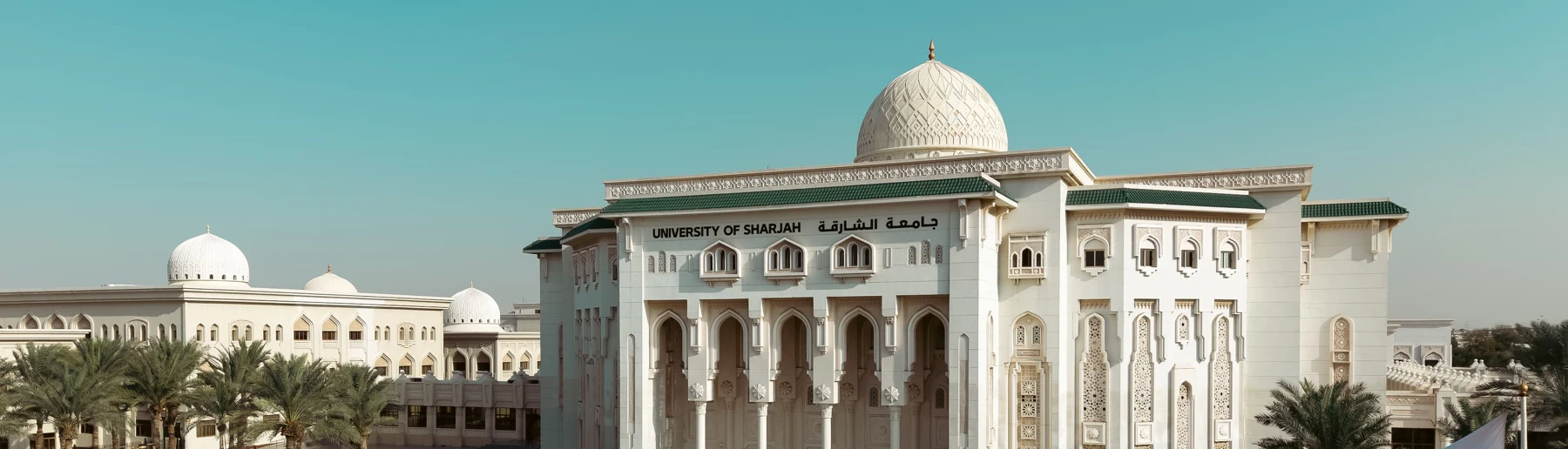
The University of Sharjah brings a wide range of academic and professional disciplines into one institutional setting. Its breadth matters because many of the questions facing society do not fit inside a single department: health involves technology and behaviour; environmental questions involve science and policy; public institutions require legal, social and managerial understanding. For a student, the university is best explored through the chosen college and the wider connections that can give a degree intellectual depth and practical purpose.
Foundation, development and public purpose
The university was established in 1997 by His Highness Sheikh Dr. Sultan bin Mohammed Al Qasimi. Its official history places Arab and Islamic culture alongside the educational needs of the UAE and Gulf region. That combination is important: the institution’s development can be understood as both an academic project and an investment in the capabilities required by society.
The history records successive additions in health, law, communication, computing and public policy, as well as libraries and clinical institutions. These developments should not be read as a current census of every active programme; they explain how the university’s scope has expanded. Applicants should use the live programme catalogue to determine what is offered for their intended level and intake.
An academic landscape with several pathways
The university’s live academic navigation spans Sharia and Islamic studies; arts, humanities and social sciences; business; engineering; health sciences; law; communication; medicine; dental medicine; pharmacy; sciences; computing and informatics; and public policy. These fields serve different educational and professional purposes. A laboratory-based degree, a clinical programme and a humanities degree should not be compared only by duration or tuition.
For each option, examine the educational sequence: foundational study, specialist courses, practical or clinical components and the final assessment. Ask which parts of the curriculum are compulsory and which allow individual direction. At graduate level, clarify the distinction between a taught qualification and a research route, including the expectations for a thesis, dissertation or professional project.
Research infrastructure and interdisciplinary work
Official research resources identify institutes covering medical and health sciences, sciences and engineering, and humanities and social sciences. The research portal also provides routes into funding, outreach, scientific publishing and technology transfer. Together, these functions describe an ecosystem that includes the production, communication and possible application of knowledge.
Students interested in research should move from an institute’s broad title to individual groups and faculty expertise. Useful questions include how ethical approval is handled, what methodological training is available and whether access to data or equipment is realistic for the proposed project. A well-defined question and a suitable supervisor matter more than a fashionable topic unsupported by a feasible plan.
Health education and the clinical environment
The university’s institutional history records the inauguration of University Hospital Sharjah and the University Dental Hospital Sharjah in 2011. These are significant milestones in the development of the surrounding health-education environment. Their existence should not be interpreted as a promise that every student receives the same clinical placement or access.
A prospective health student should ask the relevant college about the actual sequence of simulation, patient contact, placement assessment and supervision. Also distinguish graduation requirements from professional registration requirements. Clinical training carries obligations involving patient safety, confidentiality and competent practice; understanding those obligations is part of choosing the pathway responsibly.
Campus, libraries and student experience
University resources present student housing, health and wellbeing, sports and clubs alongside the academic facilities. The history of library expansion is another reminder that university study requires sustained independent work, not attendance alone. A well-used library, a reliable study routine and access to academic guidance can shape the quality of a student’s experience as much as a timetable.
On a visit, ask about the services available to the specific programme and student category. Review accommodation arrangements separately and test the likely commute at realistic times. Students with accessibility or additional support needs should discuss those needs early and request a clear explanation of available provision.
Admissions, programme fit and the financial decision
The undergraduate admissions resource separates programme discovery, eligibility, important dates, tests, documents, scholarships and submission. This sequence is useful because thresholds differ across colleges and qualification backgrounds. Meeting a minimum requirement should not be confused with a guaranteed place in a capacity-limited programme.
Before applying, compare the exact degree title, teaching language, subject requirements and any assessment or interview. Request the current fee information and clarify how tuition is calculated for the planned study load. Funding should be examined independently: eligibility, award conditions, renewal and exclusions all affect the actual cost. Use a written offer and the current academic-year schedule as the basis for a final commitment.
Pathways worth exploring.
This is an orientation to the academic landscape, not an exhaustive catalogue or confirmation of open admissions. Use the official resources below to verify the exact award and current entry conditions.
| Field or pathway | What to investigate |
|---|---|
| Medicine and health disciplines | Medicine, dentistry, pharmacy and health sciences require programme-specific scrutiny. Ask about clinical progression, supervised practice, placement arrangements and the distinction between graduation and professional licensing. |
| Engineering, sciences and computing | Compare programmes through their mathematical foundation, experimental work, design tasks and specialist content. Newer programme titles should be checked for intake availability and the exact current study plan. |
| Law, public policy and society | These fields approach institutions and public problems from different directions. Read the methods, teaching language and assessment requirements to determine whether the programme fits legal, policy or social enquiry. |
| Business and communication | Investigate the specific major rather than the college name alone. A useful comparison examines analytical work, professional communication, practical projects and the evidence of competence built across the degree. |
| Arabic, Islamic and humanities study | Review language expectations, reading demands and research methods. These programmes can involve substantial textual and interpretive work, which should be part of the applicant’s readiness assessment. |
| Postgraduate pathways | The university offers graduate routes at different levels. Confirm the exact award, taught or research structure, supervision arrangements and any discipline-specific entry conditions before preparing an application. |
Build your own decision record.
Programme and qualification
Record the exact award, level, teaching language, campus and intended intake. Keep a dated copy of the programme plan and entry conditions so that different institutions can be compared on the same basis. Ask about course sequencing, final assessment and practical or research requirements, including how additional preparation could affect the duration of study.
Cost and funding
Request current tuition and compulsory charges, then include accommodation, transport, materials and insurance where applicable. Separate confirmed figures from estimates and read deposit, instalment, refund and deferral terms. Do not deduct a potential scholarship from the budget until it is confirmed in writing, with coverage, continuation and exclusions understood.
Visit and unresolved questions
Prepare questions specific to the programme and record the answer, the responsible office and the date. Confirm practical arrangements, support, accessibility and supervision, together with later recognition where relevant. A useful visit goes beyond the appearance of the buildings: it helps explain how you will learn and manage an ordinary study week.
Questions that matter.
Can I use one entry threshold for all colleges?+
No. The admissions resource distinguishes programmes and qualification backgrounds. Match your exact school record to the intended degree and ask about subject, language, assessment and capacity conditions. A minimum threshold is not an unconditional promise of a place.
How do I evaluate a clinical programme?+
Ask about the sequence of practical learning, supervision, placement assessment and eligibility for later professional steps. Do not infer identical clinical access from the existence of a university hospital. Each college should explain the arrangements for its own students.
What is the right starting point for research study?+
Identify the academic field, a feasible question and relevant supervisory expertise. Review recent work and ask about methods training, ethics and resource access. The fit between your question and the institution’s actual expertise is more useful than a broad research slogan.
Research as an institutional ecosystem
By Gabriel Nicolaev – CyGuru · Additional sources reviewed 1 November 2026. Facts are attributed to the institution; interpretation and proposed contributions are independent.
A structure that crosses disciplinary boundaries.
The university’s research directory identifies institutes for medical and health sciences, science and engineering, and humanities and social science. This is a specific institutional structure, rather than a claim that every student follows the same research pathway. The research leadership’s overview also places scientific research within the university’s contribution to the development of the UAE.
Our reading is that an applicant should examine the connections between these levels: the degree programme, the academic department, a research group and the institute that supports it. A prominent institute does not by itself establish that a particular supervisor is accepting students or that an undergraduate has laboratory access. Those are programme-level questions, best answered by the relevant academic unit.
A concrete example: water and engineering.
The Research Institute of Sciences and Engineering describes a desalination research group concerned with energy-efficient water desalination. The specific research theme gives a prospective researcher something more useful than an undifferentiated claim of innovation: a problem area to investigate and an institutional route to follow.
Before choosing a dissertation topic, examine recent work by the relevant group, identify methods that fit your preparation and ask what facilities, supervision and data can actually support the proposed project. This is editorial guidance, not a statement of an available funded position. A research topic becomes a viable student opportunity only when the programme, supervisor and resources are confirmed together.
What an institutional contribution could clarify.
For a future factual review, the most valuable contribution would be a dated route from each featured research theme to its official academic contact and programme information. A reviewer could distinguish public events, research descriptions and application opportunities, because they represent different kinds of access.
The proposed pilot would test that distinction on a small sample. The desired output is a documented path a reader can follow, with unresolved questions visibly recorded. Publication would remain independent, and any institutional factual review would be attributed only after the relevant institution agrees to that description.
Return to the wider perspective ↗Official resources for this portrait.
Institutional facts are grounded in the resources below. Interpretation and comparison guidance are independent editorial content. Programmes, fees and admission conditions may change after the review date.
- Institutional history ↗
- University and colleges ↗
- Research ↗
- Research institutes ↗
- Undergraduate admissions ↗
- Programme updates ↗
An independent editorial portrait. Inclusion does not imply endorsement, partnership or an admission offer from the institution.