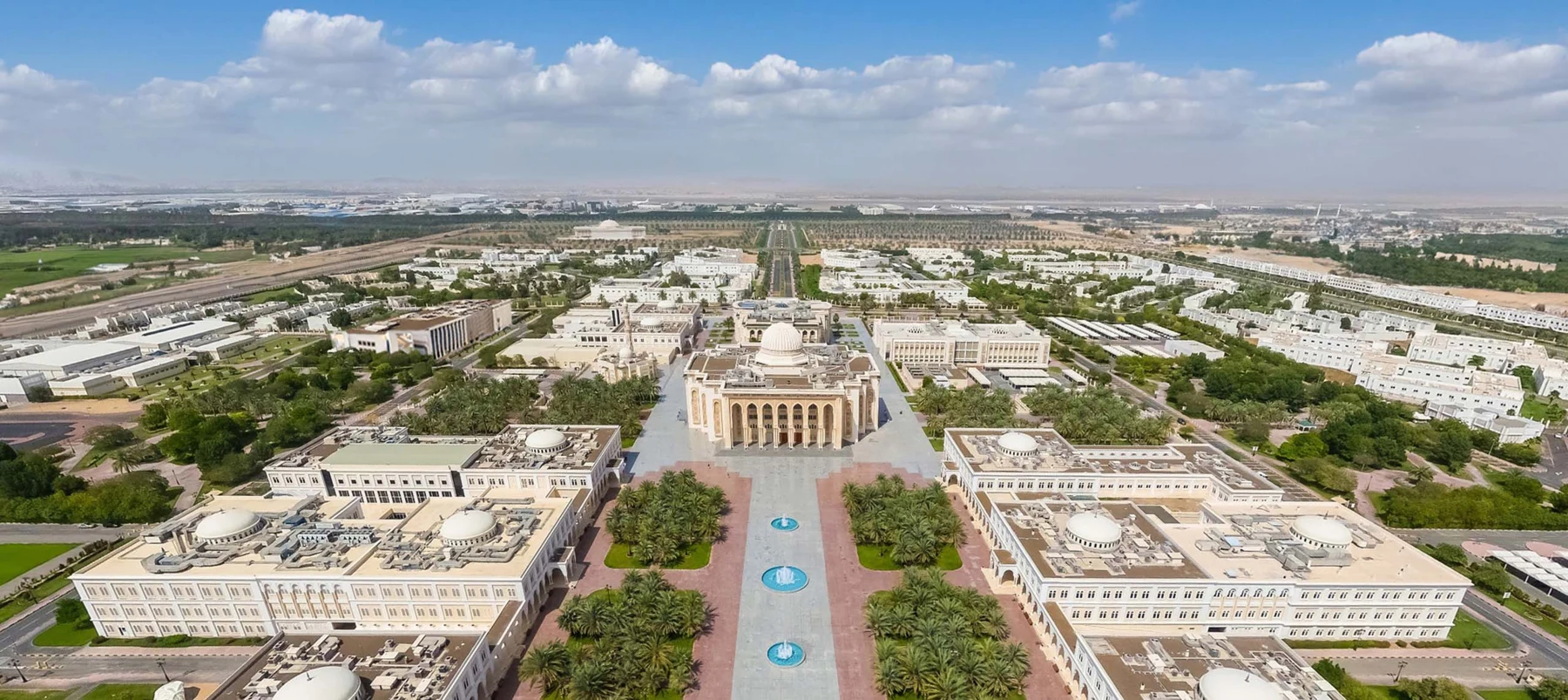
American University of Sharjah occupies a distinctive position in the emirate’s higher-education landscape: an institution established in Sharjah, drawing on an American model of university education, and connecting specialist study with a wider intellectual experience. For a prospective student, its significance lies in the relationship between a chosen major, the surrounding academic community and the opportunities to build a substantial body of work over several years. This profile examines that relationship rather than reducing the university to a ranking or a single admissions statistic.
Foundation and educational identity
Founded in 1997 by His Highness Sheikh Dr. Sultan bin Mohammed Al Qasimi, Member of the Supreme Council and Ruler of Sharjah, AUS began teaching on 4 October of that year. Its development belongs to a broader story of investment in education as an enduring civic institution. The university’s official history records its early licensing, the introduction of graduate study and the graduation of its first class.
The relevant lesson for a visitor is continuity: a university is built through successive generations of students, faculty and academic practice. For an applicant, the American-model identity should prompt practical questions about major requirements, general education, elective space, assessment and the possibility of combining interests through a minor. These features should be checked against the current catalogue for the intended degree, not assumed from the institutional label.
Four academic communities
The university organises its academic offering through the College of Architecture, Art and Design; College of Arts and Sciences; College of Engineering; and School of Business Administration. This structure creates several different kinds of educational experience within one institution. A design student may build a portfolio through repeated critique; a scientist may develop experimental and quantitative skills; an engineer may work through systems and design constraints; a business student may examine organisations, markets and decisions.
Applicants should therefore compare the experience inside the intended college. Read the sequence of required courses, the nature of final-year work and the balance between individual and group assessment. The important question is not simply whether a subject appears on a programme list, but how a student is progressively prepared to practise it.
Research and the questions behind it
Official research resources identify work in materials; entrepreneurship, innovation and sustainable development; and energy, water and the sustainable environment. These themes connect technical investigation with practical challenges. Their presence provides a starting point for identifying supervisors, laboratories and projects rather than a guarantee of access to a particular opportunity.
A research-minded student should look for a precise fit: a faculty member’s recent publications, the methods used by a group and the conditions for student participation. At postgraduate level, a broad interest in sustainability or technology needs to become a focused research question with a feasible method. Undergraduate applicants can ask how research literacy enters ordinary teaching and whether supervised projects are available within their programme.
Campus as an everyday learning environment
AUS is located in University City. Its prospective-student information describes a full-service campus with academic and research spaces, sports and recreation, and student accommodation. The practical value of a residential university environment depends on how a student uses the hours between scheduled classes: reading, studio work, conversation, exercise and participation in organised activities.
During a visit, prioritise the spaces used by the intended major. Ask about library access, studio or laboratory hours, academic advising and accessibility arrangements. Accommodation should be considered as a separate application and contractual decision, with questions about availability, supervision, meals, transport, vacation periods and the full cost.
Accreditation: read the exact scope
AUS publishes information on institutional accreditation through the Middle States Commission on Higher Education and on specialised accreditation associated with engineering, computing, architecture and business. Institutional recognition and programme-specific recognition answer different questions; neither should be treated as an automatic professional licence in every country.
The sensible approach is to match the exact degree title to the current accrediting record, then examine any requirements in the country where the graduate expects to work or pursue further study. A professional architecture, engineering or accounting pathway can include examinations, supervised practice or registration after graduation. The receiving professional body remains the appropriate authority for those requirements.
Admissions and financial planning
Begin with the official prospective-student route and the requirements for the chosen qualification background. Create a record of academic documents, language evidence, required tests and the conditions attached to any offer. Receiving a student reference number is not the same as receiving an admission offer.
AUS maintains a dedicated grants and scholarships resource. Treat each funding route as a separate set of eligibility, availability and continuation conditions. Build a budget using the current fee schedule and a realistic course load, then add accommodation, food, transport, books and other compulsory expenses. Compare the written net cost after an actual award rather than assuming that a possible discount will be granted.
Pathways worth exploring.
This is an orientation to the academic landscape, not an exhaustive catalogue or confirmation of open admissions. Use the official resources below to verify the exact award and current entry conditions.
| Field or pathway | What to investigate |
|---|---|
| Architecture, art and design | Architecture, interior design, graphic design and related creative routes. Compare studio sequence, critique, the final portfolio and any professional recognition relevant to the exact degree. |
| Arts and sciences | Fields include the natural sciences, mathematics, humanities and social sciences. Examine the balance between disciplinary depth, quantitative or language preparation and the opportunity to connect a major with other interests. |
| Engineering and computing | Explore the current engineering and computing programme list. Look beyond the title to laboratory work, design assessment, technical electives and the kind of capstone evidence expected at graduation. |
| Business administration | The business school offers several routes through business and economics. Compare the analytical foundation, specialist sequence and applied work rather than treating all business degrees as equivalent. |
| Graduate study | Review the live master’s and doctoral catalogue. Identify the supervisor or academic area, the research or taught structure and the evidence required to demonstrate readiness for advanced work. |
Build your own decision record.
Programme and qualification
Record the exact award, level, teaching language, campus and intended intake. Keep a dated copy of the programme plan and entry conditions so that different institutions can be compared on the same basis. Ask about course sequencing, final assessment and practical or research requirements, including how additional preparation could affect the duration of study.
Cost and funding
Request current tuition and compulsory charges, then include accommodation, transport, materials and insurance where applicable. Separate confirmed figures from estimates and read deposit, instalment, refund and deferral terms. Do not deduct a potential scholarship from the budget until it is confirmed in writing, with coverage, continuation and exclusions understood.
Visit and unresolved questions
Prepare questions specific to the programme and record the answer, the responsible office and the date. Confirm practical arrangements, support, accessibility and supervision, together with later recognition where relevant. A useful visit goes beyond the appearance of the buildings: it helps explain how you will learn and manage an ordinary study week.
Questions that matter.
How should I compare majors within AUS?+
Compare the required course sequence, electives, final project and the work produced by students. Ask whether a minor or change of major is feasible under current rules, and how it would affect time and cost. The flexibility you need should be confirmed before relying on it.
Does an international accreditation settle every recognition question?+
No. Check the exact degree and current accrediting scope, then consult the professional or recognition authority in your intended destination. Academic recognition, entry to further study and permission to practise a regulated profession can involve different decisions.
What should I request before committing financially?+
Request the current fee schedule, the conditions of the admission offer and any actual funding award, together with accommodation and withdrawal terms. Compare a realistic total budget rather than tuition alone or an assumed scholarship.
Breadth, specialisation and public relevance
By Gabriel Nicolaev – CyGuru · Additional sources reviewed 1 November 2026. Facts are attributed to the institution; interpretation and proposed contributions are independent.
An educational model with breadth built in.
AUS describes general education as a complement to professional study, with intellectual inquiry and critical reflection at its core. That distinction matters when comparing universities: the title of a major does not describe the whole undergraduate education. Learning outside the major can affect how a student writes, interprets evidence and understands the social setting of professional work.
For a prospective student, a useful exercise is to read a degree study plan alongside its general-education requirements. Which courses build depth, which introduce other ways of thinking, and where does the programme allow genuine choice? The published catalogue for the student’s cohort is the controlling academic reference; this portrait is an independent explanation of what to examine.
Research themes with a local conversation.
The university’s research-centres directory includes energy, water and environmental sustainability; entrepreneurship and innovation; and Arab studies and Islamic civilizations. These examples show distinct lines of inquiry within the same institution. They should not be mistaken for a list of open student projects or for equivalent access across all departments.
A prospective researcher can use the centres as a starting map: locate the intellectual question, then follow it to named faculty, current work and the relevant degree. For a student interested in enterprise, the useful distinction is between studying entrepreneurship, receiving project support and actually incorporating a business. Each involves a different process and different evidence.
Read strategy as a commitment to be examined.
The published AUS 2025–2030 strategy links educational experience, research and creative work, people, community engagement and responsible management of resources. It also describes monitoring through defined indicators. These are institutional priorities and proposed directions; a strategy should not be presented as proof that every intended outcome has already occurred.
Our editorial interpretation is that this gives a prospective collaborator a better starting point than a general request for partnership. A bounded bilingual public-information project could be discussed against a relevant institutional priority, with its own deliverable and assessment. Participation would still depend on an agreement; AUS has not endorsed this platform through inclusion in this portrait.
Return to the wider perspective ↗Official resources for this portrait.
Institutional facts are grounded in the resources below. Interpretation and comparison guidance are independent editorial content. Programmes, fees and admission conditions may change after the review date.
- History and foundation ↗
- Colleges and study pathways ↗
- Research centres ↗
- Accreditation information ↗
- Funding ↗
- Admissions contact ↗
An independent editorial portrait. Inclusion does not imply endorsement, partnership or an admission offer from the institution.